 Writer:
買えちゃうカンパニー
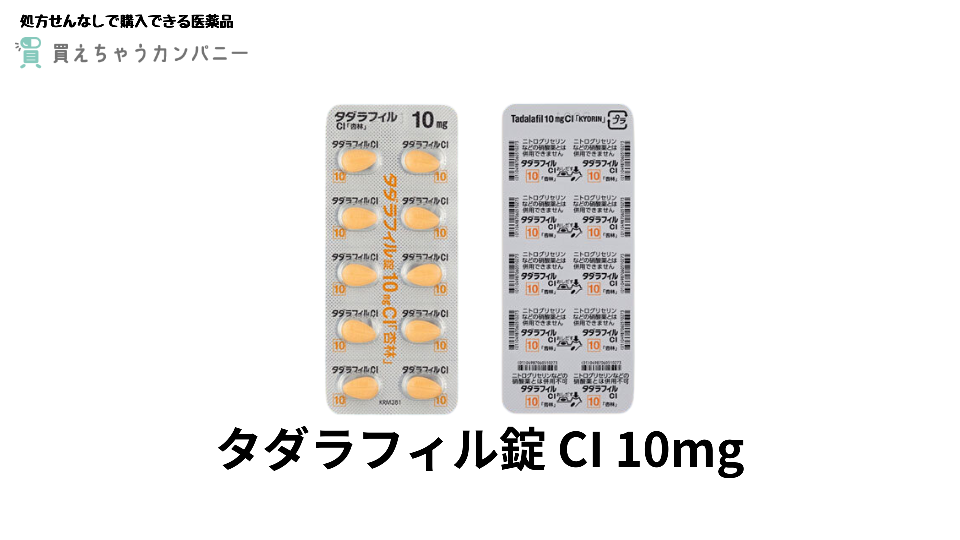
2 tablets: ¥2,500 (tax included)
10 tablets: ¥10,000 (tax included)
What is tadalafil (brand-name: Cialis)?
Tadalafil is an active ingredient classified as a treatment for erectile dysfunction. Its brand-name product is Cialis, a film-coated tablet containing 10 mg of tadalafil per tablet. Although there is also a treatment for urinary disorders associated with benign prostatic hyperplasia that contains the same active ingredient, it is a different medication.
Its mechanism of action is related to the local release of nitric oxide, or NO, in the body in response to sexual stimulation. Tadalafil inhibits PDE5, an enzyme that breaks down a substance called cGMP. As a result, the cGMP concentration in the corpus cavernosum increases, smooth muscle relaxes, and blood flow to the erectile tissue increases, making an erection more likely to occur.
The important point is that tadalafil is not a drug that causes sexual arousal simply by taking it. The package insert also clearly states that it is neither an aphrodisiac nor a libido-enhancing drug. In other words, it helps produce an erection when sexual stimulation is present; it does not increase sexual desire itself.
Indications and effects: Who is it used for?
The indication listed in the package insert is erectile dysfunction. More specifically, it is intended for “patients who are unable to achieve or maintain an erection sufficient for satisfactory sexual intercourse.”
However, this is not a medication that anyone can use casually. The package insert states that, before administration, the patient’s medical history should be reviewed and examinations performed to diagnose erectile dysfunction and its underlying conditions, and that use should be limited to patients who require clinical treatment based on an objective diagnosis.
ED can be associated not only with aging and stress, but also with diabetes, hypertension, dyslipidemia, cardiovascular disease, and other conditions. Rather than temporarily improving symptoms with medication alone, it is also important to check for underlying diseases and overall health.
Dosage and administration
In general, adults should take 10 mg of tadalafil once daily, approximately one hour before sexual intercourse. It should be taken no more than once a day, with at least 24 hours between doses.
However, dosage restrictions apply to people with liver or kidney problems. The package insert states that patients with mild or moderate hepatic impairment should not exceed 10 mg, while those with moderate or severe renal impairment should start at 5 mg. Patients with severe renal impairment should not exceed 5 mg.
In addition, people taking strong inhibitors of the metabolic enzyme CYP3A4 may experience increased blood concentrations of tadalafil. Therefore, treatment should be started at a low dose and sufficient time should be allowed between doses. When using 10 mg, at least 48 hours should elapse between doses, and the dose should not exceed 10 mg.
Regarding food, the package insert states that it may be administered regardless of whether it is taken with food.
Contraindications: Who should not use it?
With tadalafil, it is particularly important to know which medications must not be taken together and which medical conditions contraindicate its use.
First, people taking heart medications must not use it. Examples include nitroglycerin, amyl nitrite, isosorbide dinitrate, nicorandil, and riociguat (Adempas). Combining these medications may enhance the blood-pressure-lowering effect and cause an excessive drop in blood pressure.
In addition, the package insert lists as contraindications people for whom sexual activity is considered inappropriate due to cardiovascular disorders or other conditions; those with unstable angina; those who have experienced angina during sexual intercourse; those with uncontrolled arrhythmia, hypotension, or uncontrolled hypertension; those with a history of myocardial infarction within the past three months; those with a history of cerebral infarction or cerebral hemorrhage within the past six months; those with severe hepatic impairment; and those with retinitis pigmentosa.
Although ED medications are sometimes casually regarded as “lifestyle-improvement drugs,” they involve numerous precautions related to blood pressure and the heart. If you take medication for angina, heart disease, or blood pressure, do not use tadalafil on your own; consult a specialist physician or pharmacist.
People who require caution
Even when use is not contraindicated, some people require careful evaluation.
The package insert advises caution in people with anatomical abnormalities of the penis, conditions that may predispose them to priapism, those using PDE5 inhibitors or other ED medications, those with bleeding disorders or peptic ulcers, those with severe ED, and those with inadequately controlled hypertension.
Older adults are generally considered to have reduced physiological function. In addition, a study comparing a single 10 mg dose of tadalafil in healthy older and younger adults reported that the AUC in older adults was approximately 25% higher than in younger adults.
In other words, the effects and side effects of the medication may differ in older people. Even if it becomes available for purchase at pharmacies, it is important to accurately inform the pharmacist about any medical conditions, current medications, and past medical history.
Medications and foods requiring caution when combined
In addition to contraindicated combinations, there are medications that require caution when used together.
The package insert lists the CYP3A4 inhibitors ketoconazole, itraconazole, clarithromycin, telaprevir, and grapefruit juice. These may increase the blood concentration of tadalafil.
HIV protease inhibitors such as ritonavir, indinavir, saquinavir, and darunavir also require caution when used together. CYP3A4 inducers such as rifampicin, phenytoin, and phenobarbital may decrease the blood concentration of tadalafil.
α-blockers, antihypertensive drugs, carperitide, and vericiguat also require caution. Since tadalafil itself lowers blood pressure through vasodilation, combining it with these medications may increase the risk of hypotension.
Side effects
Hypersensitivity is listed as a serious adverse reaction in the package insert. Rash, urticaria, facial edema, exfoliative dermatitis, and Stevens-Johnson syndrome may occur.
Other adverse effects listed include flushing, palpitations, hot flashes, chest pain, hypotension, blurred vision, eye hyperemia, indigestion, nausea, diarrhea, back pain, myalgia, headache, dizziness, nasal congestion, fatigue, and malaise. Events reported with an unknown frequency include myocardial infarction, sudden cardiac death, syncope, stroke, priapism, and prolonged erection.
Particular caution is required if an erection lasts four hours or longer. The package insert states that prolonged erections lasting four hours or longer, or painful priapism lasting six hours or longer, have been reported very rarely overseas. If not treated promptly, these conditions may damage penile tissue and cause permanent impairment of erectile function; patients should therefore be instructed to seek immediate medical attention.
If sudden deterioration or loss of vision occurs, discontinue use and promptly consult an ophthalmologist.
Other precautions
Regarding alcohol, foreign clinical pharmacology studies found no mutual effect on blood alcohol or tadalafil concentrations. However, dizziness and orthostatic hypotension were reported in subjects who consumed large amounts of alcohol. It is safer to avoid using tadalafil while heavily intoxicated.
Caution is also required when driving or performing work at heights. Because dizziness and visual disturbances were observed in clinical trials, the package insert advises caution when operating potentially dangerous machinery.
Can tadalafil 10 mg tablets be purchased at a pharmacy without a prescription?
Following the approval of Cialis (active ingredient: tadalafil) as a specially designated over-the-counter medication on May 20, 2026, it may become more common to see it at pharmacies and drugstores. However, specially designated over-the-counter medications are not drugs that “anyone can freely purchase”; confirmation and information provision by a pharmacist are required. When purchasing, disclose your current medications, medical conditions, and past medical history, and ask the pharmacist to confirm whether it is safe for you to use.
At the same time, tadalafil 10 mg products for the treatment of erectile dysfunction have been partially removed from the prescription-only designation, making it possible to purchase them without a prescription.
Our pharmacy’s prices
Tadalafil tablets 10 mg
2 tablets ¥2,500 (tax included)
10 tablets ¥10,000 (tax included)